
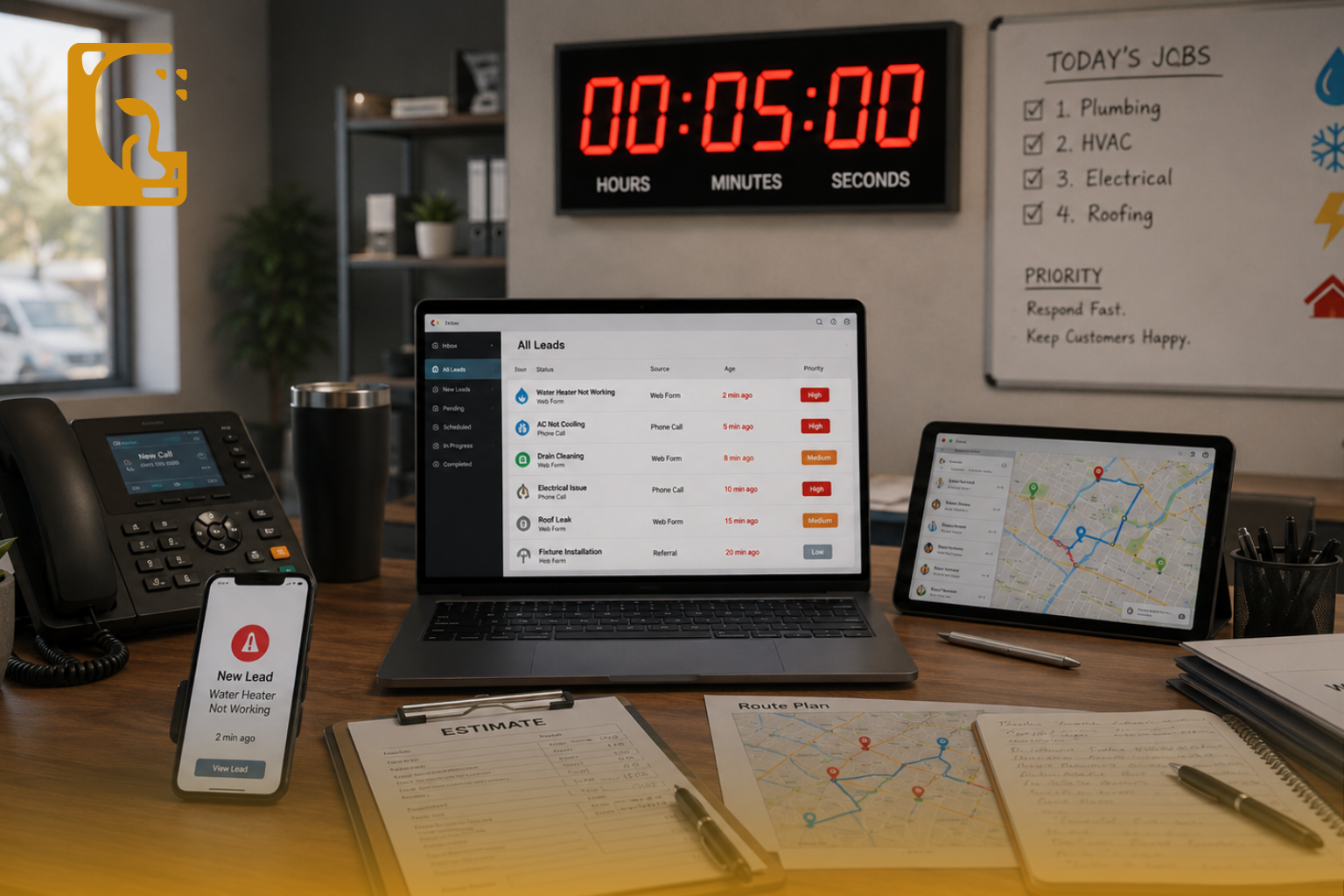
Losing a job is not always about price, reputation, or the quality of your work. More often, it happens because another company replies first and starts the conversation before you do.
Most home service companies do not have a lead problem.
They have a speed to lead problem.
When a homeowner fills out a form, calls after hours, or urgently visits a website, they are not waiting for just one company. They reach out to several providers at once and compare who replies, who seems trustworthy, and who makes the next step easy.
Often, the first company to respond has the advantage. If you contact leads within five minutes, they are much more likely to convert. Waiting 30 minutes or more can greatly reduce your chances of reaching the prospect.
That is the real issue.
If your team is slow to respond, your competitor does not need a better sales pitch. They only need to reply before you.
Slow Response Creates Silent Revenue Leaks
Most businesses do not notice this problem right away because leads keep coming in.
The forms are getting submitted. The calls are happening. The ad spend is running. Website traffic looks fine.
But if your speed to lead is too slow, many of those opportunities never become real conversations.
Homeowners often reach out to several companies, and response time can decide who gets the job. Many businesses pay for leads they never actually get to work with because the opportunity goes cold before a conversation even starts.
For example, if a company gets 10 leads per week at $120 each, slow response can add up to $57,600 per year in missed opportunities.
This is why speed to lead is an operational problem, not just a sales problem.
If your process is not fast and consistent, you lose jobs before your team even has a chance to sell.
Why the First Meaningful Conversation Matters So Much
Fast response is not just about appearing quick.
It is about being the first to take action.
Imagine three companies get the same inquiry. One responds in 2 minutes, another in 7 minutes, and the last in 45 minutes. The first company to engage has the best chance to answer questions, reduce uncertainty, and guide the next step.
The old way is simple: a lead comes in, someone calls later, the call goes to voicemail, and the job is lost.
The better way is just as clear: a lead comes in, your speed to lead process kicks in, the conversation starts, and the estimate gets booked.
For busy homeowners, this matters because they often decide who seems most available, most organized, and easiest to work with long before they compare estimates.
In other words, how quickly you respond becomes part of the buying experience.
Where Home Service Companies Usually Lose Speed
In most cases, slow response is not because of a lazy team. It is usually because of a weak system.
Home service companies usually lose speed in five places:
1. Form submissions sit too long
A web lead comes in, but no one responds right away. By the time someone follows up, the homeowner is already talking to another provider.
2. Website visitors have no live path to a conversation
If someone has a question and your site does not give them a quick answer, they leave.
3. Missed calls go nowhere
Overflow calls, after-hours calls, and busy times create gaps that lead to lost jobs.
4. Lead routing is unclear
Even when interest is real, the handoff is messy. No one knows who is responsible for the next step.
5. Follow-up depends on memory
When follow-up is manual, response speed becomes inconsistent.
This is why speed to lead system design matters. Sales Leopard’s approach uses AI automation, trained operators, CRM-connected workflows, and process visibility. The goal is not random activity, but a managed system that keeps opportunities moving without relying on human memory every time.very time.
What Fast Response Actually Looks Like
Speed-to-lead does not come from working harder. It comes from having a system that responds first.
That system includes a few practical components.
Instant form response
A form submission should trigger a call or text within seconds, with basic information captured and routed or scheduled right away. This removes inbox delay and gives the lead a real response while their intent is still high.
24/7 website conversations
Website chat lets visitors engage right away instead of leaving the site. It can answer basic questions, collect information, and hand the lead off smoothly.
Phone coverage
Missed calls, after-hours demand, and overflow can all lead to lost opportunities. With the right phone coverage and AI-assisted logging, details can be captured and sent directly to your team or CRM.
CRM-connected routing and follow-up
Automated follow-up, CRM-integrated processes, dashboards, and trained support help turn interest into booked conversations.
The overall framework is simple: AI delivers speed, people provide direction, and process creates consistency.
A Practical Framework for Home Service Companies
If you want to reduce lead leakage, focus on this sequence:
Capture every inquiry immediately. Do not wait for someone to get to it.
Start a conversation fast. Use form response, chat, or phone coverage to engage while intent is high.
Route every lead into one system. If the lead is not in your CRM or workflow, you risk losing it.
Automate the first steps. Response, logging, reminders, and handoff should not depend on memory.
Make follow-up consistent. The businesses that win are the ones that stay available and organized, not just those that advertise more.
Quick Self-Check
Ask yourself:
- Do form leads get a response in minutes?
- Can a prospect start a conversation on your website right away?
- Are missed and after-hours calls covered?
- Does every inquiry route into your CRM cleanly?
- Is follow-up triggered by a system, not memory?
- Can your team clearly see where jobs are being lost?
If the answer is not consistently, your speed to lead process may be where the leak is.
Final Thought
Home service companies rarely lose jobs only because of price.
They lose jobs because someone else answered first, sounded ready first, and made the next step easier.
That is why speed to lead matters so much.
The businesses that win are not always the loudest. They are the easiest to reach, the fastest to respond, and the most prepared to turn a lead into a booked conversation.
And when that system is in place, more conversations turn into more estimates, more inspections, and more jobs.
If you want to see where slow response is costing you jobs, book a discovery call with us. We will help you find the gaps in your lead capture, phone coverage, routing, and follow-up process so you can improve your speed to lead, book more conversations, and stop losing work to faster competitors.
Leave a Reply